Finishing Mohs surgery often brings relief as well as questions: when should I return, and what should I look for at home? Follow-up supports recovery and ongoing skin surveillance. Treating one tumour does not remove the possibility of developing others in the future.
Wound healing and skin surveillance follow different timelines
Early reviews focus on the operated area and wound care. Suture removal, dressing changes and returning to activities depend on the repair and the individual. You should leave with written instructions and a way to contact the team if problems arise.
Like other skin operations, Mohs can cause bleeding, pain, infection and scarring, as well as changes in sensation. If you are concerned about your recovery, contact your surgical team rather than waiting for the next review. Do not change treatments or wound care on your own.
Why examine the rest of the skin too?
Follow-up involves more than checking the scar. After a basal cell carcinoma, there is a risk of recurrence and of developing a new skin cancer. Your dermatologist may therefore examine both the treated area and other sites. A new lesion does not necessarily mean the previous tumour has returned.
There is no single schedule for everyone
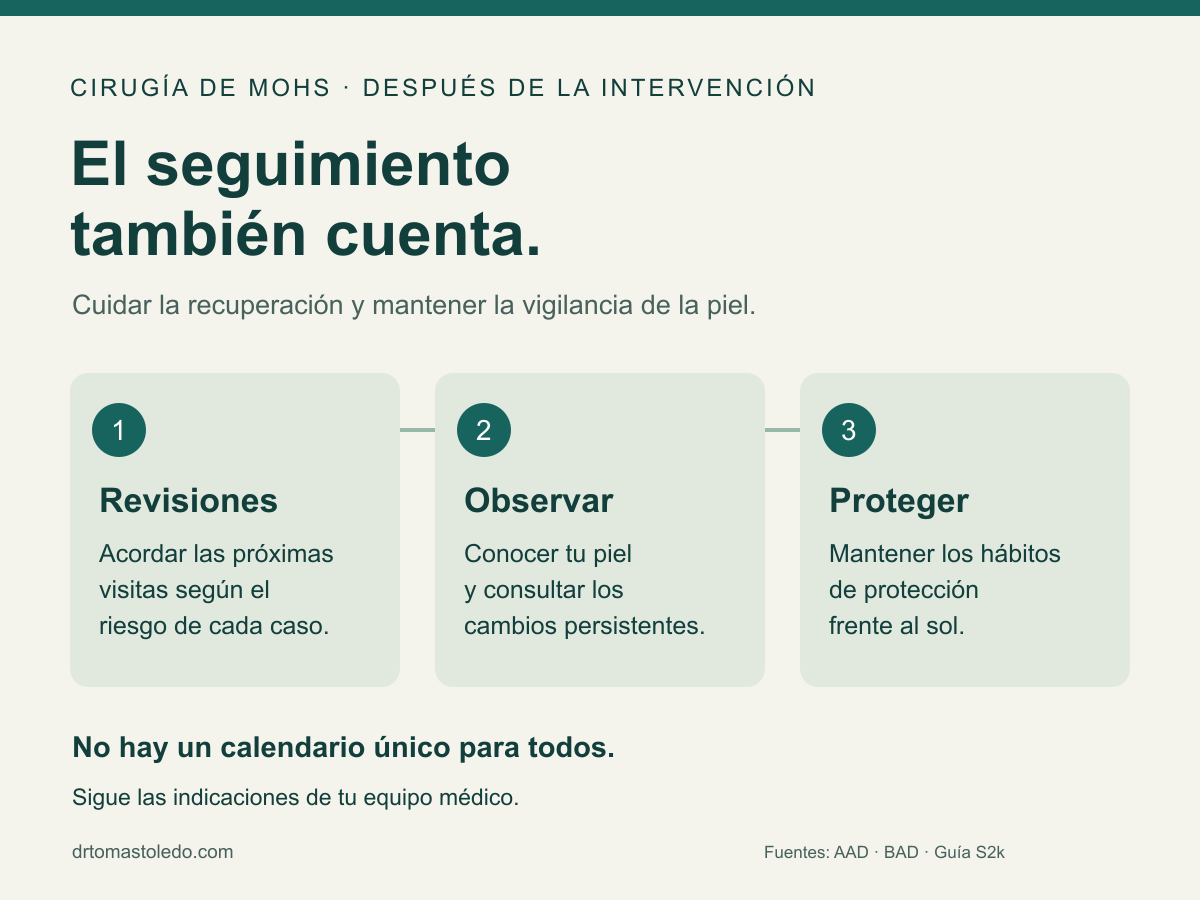
The frequency of reviews is tailored to the diagnosis, tumour characteristics and medical history. Guidelines distinguish lower-risk and higher-risk situations. Having had several tumours or being immunosuppressed may change the plan. Follow-up for a high-risk squamous cell carcinoma may require a different approach from follow-up for a low-risk basal cell carcinoma.
Ask when your next appointment will be and which changes should prompt an earlier review. The schedule should be clear, but it does not replace a consultation if something new concerns you. Not everyone needs the same tests: the team decides which are appropriate in each case.
Three habits between appointments
Check your skin, including the treated area, as advised by your dermatologist. Seek advice about new lesions or persistent changes, particularly a wound that does not heal. Checking your skin helps identify changes but cannot confirm a diagnosis on its own.
Keep protecting your skin from the sun: seek shade, wear protective clothing and follow sun-protection advice. Bring your questions and any changes you have noticed to your appointment so that reviews also address what you need to know.
Mohs is part of individualised treatment
Mohs is used for selected tumours when margin control and tissue preservation are especially important. It is not necessary for every skin cancer: conventional surgery and, in selected situations, other treatments may be alternatives. Treatment and follow-up are chosen for each individual case, without a guarantee that recurrence will never occur.
Read more about Mohs surgery or request an assessment.
Further information and sources
American Academy of Dermatology: follow-up after basal cell carcinoma.
S2k guideline on basal cell carcinoma, 2023 update and AAD: cutaneous squamous cell carcinoma.
British Association of Dermatologists: Mohs micrographic surgery.
General patient information. Your medical team’s advice must be tailored to your diagnosis and recovery.
See how to interpret a biopsy with involved margins and the professional profile of Dr Tomás Toledo Pastrana, dermatologist and Mohs surgeon. Original editorial update: 10 November 2026.